ODM High Thermal Conductivity Aluminum PCB from Reliable China Suppliers and Factory Suppliers, Companies
Product Description
| Structural Layer | Common Materials | Core Function |
|---|---|---|
| Circuit layer | Electrolytic copper foil ranging from 18 to 140μm | Make circuits and carry the welding of components |
| Insulating layer | Thermal conductive epoxy resin / ceramic filling adhesive | Insulation isolation + heat conduction (thermal conductivity 0.8–8 W/m·K) |
| Metal base layer | Aluminum alloy (mainly 6061/5052) | The heat dissipation base quickly disperses the heat conducted by the insulation layer |
-
💡 LED Lighting
LED beads (especially high-power LEDs) generate concentrated heat. Aluminum substrates are the core substrates for street lamps, spotlights, and panel lights, which can keep the temperature rise of the beads within a safe range.
-
⚡ Power Electronics
Power modules (MOSFETs, IGBTs) of power adapters, frequency converters, and inverters need to dissipate heat quickly to prevent component burnout.
-
🚗 Automotive Electronics
On-board LED headlights, power controllers in the engine compartment, motor driver boards for new energy vehicles.
-
🔊 Audio Equipment
Power amplifier boards, audio power modules — reducing sound quality distortion caused by heat generation.
The metallic thermal conductivity of aluminum plates can quickly transfer the heat generated by components (such as LEDs, power transistors) to the external heat dissipation structure, significantly reducing temperature rise and extending service life.
The density of aluminum alloy is much lower than that of copper and steel, and its bending resistance and impact resistance are superior to those of ordinary PCBs, making it suitable for portable and vehicle-mounted devices.
The coefficient of thermal expansion (CTE) of aluminum alloy can be matched with components, reducing warping and solder joint cracking caused by temperature changes.
The insulation layer can withstand high voltage (common withstand voltage ≥3000V AC), preventing short circuits between the circuit and the aluminum plate.

Design Considerations
The heat dissipation pads need to be fully in contact with the aluminum plate: under the pads of high-power devices, "heat-conducting pads" should be designed and connected to the side of the aluminum plate through metallized vias (≥0.3mm) to enhance heat dissipation.
Line width adaptation current: Aluminum substrates are mostly used in high-current scenarios. The line width should be designed according to "1A current corresponding to 0.3mm line width (copper thickness 35μm)" to avoid heat generation.
Avoid burrs during aluminum plate cutting: Burrs on the edges of aluminum plates can easily puncture the insulation layer, so chamfering (≥0.5mm) treatment is required.

Manufacturing Process
Insulation layer bonding: High-temperature and high-pressure (180℃ / 3MPa) bonding is required to ensure that the insulation layer is free of bubbles and the peel strength is ≥1.0 N/mm.
Surface treatment: Tin plating / nickel-gold plating is preferred, and OSP (organic film has poor heat resistance) should be avoided.
Forming method: CNC milling is adopted (instead of die-cutting for ordinary PCBs) to ensure the flatness of the aluminum plate edges.
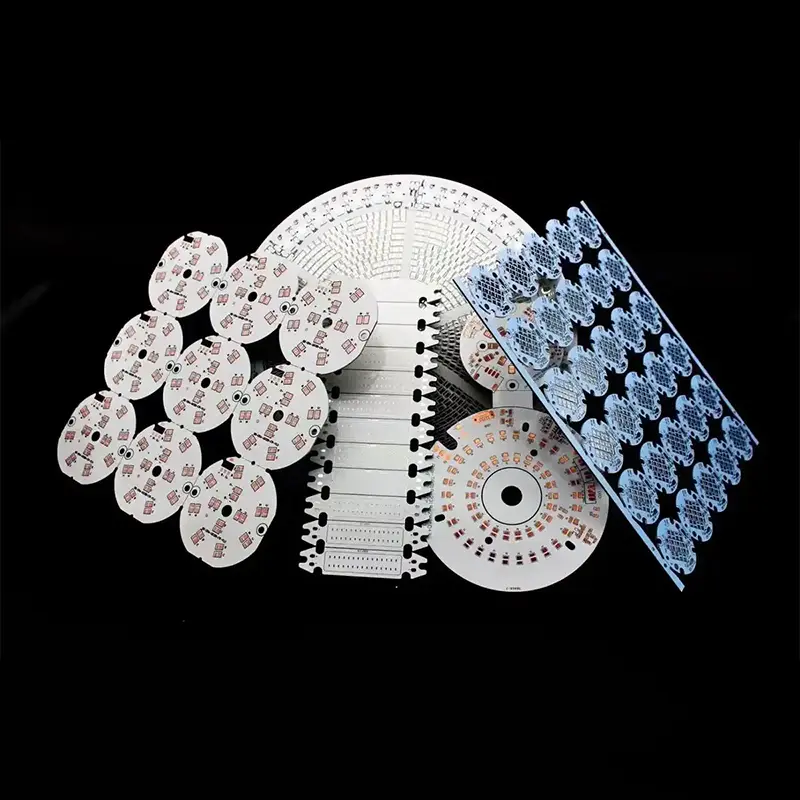
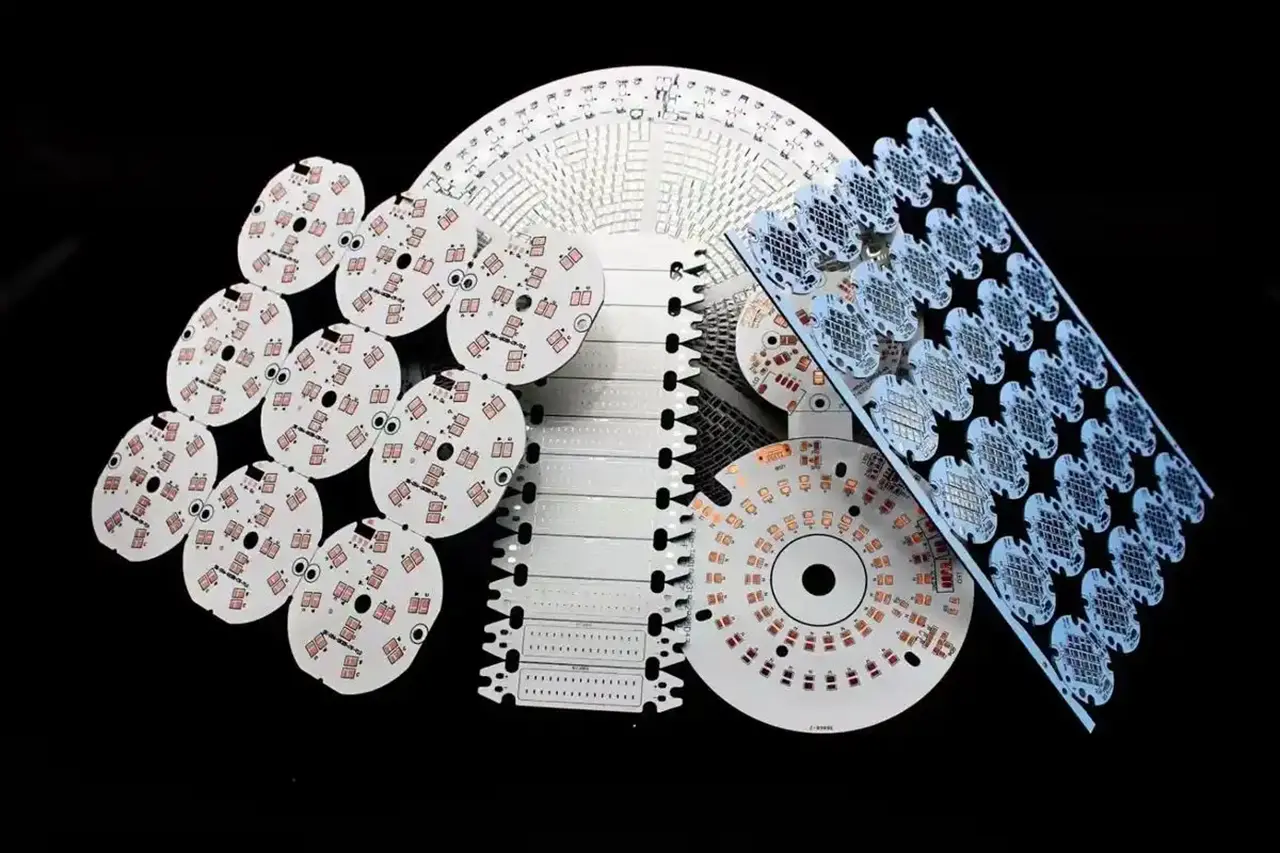
An aluminum PCB (also known as an aluminum substrate or metal-core PCB) consists of three layers: a copper circuit layer, a thermally conductive insulating layer, and an aluminum alloy base. Unlike standard FR4 PCBs, the aluminum base provides superior heat dissipation, making it ideal for high-power applications such as LED lighting and power electronics.
Aluminum PCBs offer excellent thermal conductivity (0.8–8 W/m·K), lightweight construction, high mechanical strength, good dimensional stability, and strong insulation safety (withstand voltage ≥3000V AC). These properties extend component lifespan and improve overall product reliability.
Aluminum PCBs are widely used in LED lighting (street lamps, spotlights, panel lights), power electronics (adapters, inverters, frequency converters), automotive electronics (LED headlights, motor driver boards for EVs), and audio equipment (power amplifier boards and audio power modules).
The most commonly used aluminum alloy grades for PCB manufacturing are 6061 and 5052. These grades offer an excellent balance of thermal conductivity, mechanical strength, corrosion resistance, and machinability, making them well-suited for demanding electronic applications.
Recommended surface treatments for aluminum PCBs include tin plating and nickel-gold (ENIG) plating. OSP (Organic Solderability Preservative) is generally not recommended due to its poor heat resistance, which may compromise performance in high-temperature environments.
Key design rules include: ensuring heat dissipation pads are fully in contact with the aluminum base using metallized vias (≥0.3mm); sizing line widths appropriately for current load (0.3mm per 1A at 35μm copper thickness); and applying chamfering (≥0.5mm) on aluminum plate edges to prevent insulation layer damage from burrs.